

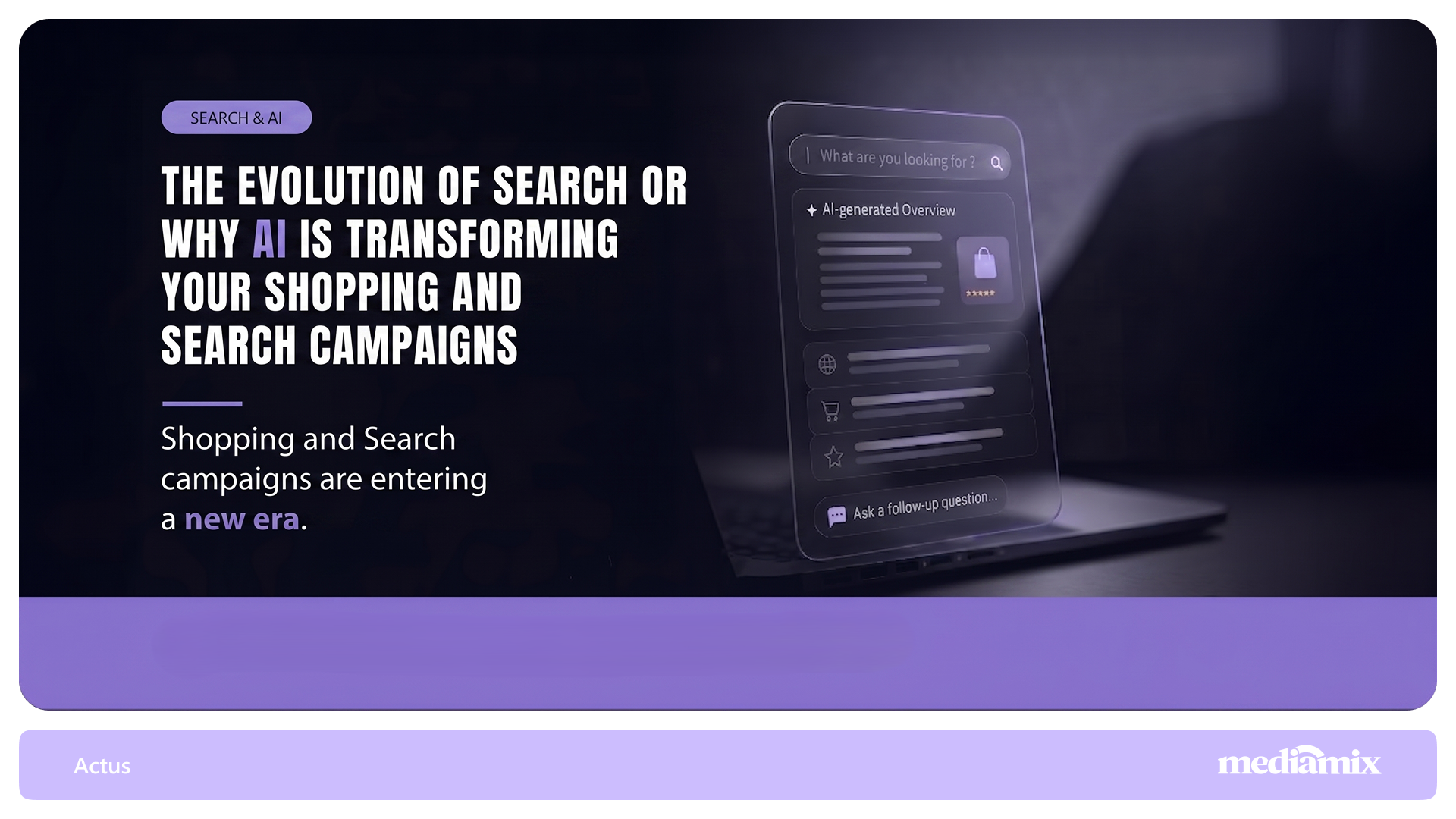
For more than twenty years, Search has been built around keywords. The digital marketing landscape is undergoing an unprecedented transformation. What we considered emerging trends a few months ago has become a statistical reality in 2026. The way internet users search has radically changed.
At Mediamix, we follow these developments closely to anticipate their impact on our clients' performance. Here is why the arrival of AI Max and the transformation of Search are changing the rules of the game.
What this evolution concretely changes for advertisers
AI-driven Search evolution is profoundly transforming the way digital campaigns are managed.
Advertisers are gradually losing some of their historical manual control to automated optimization systems based on user signals, content, and behavioral data.
In this new model, performance no longer depends solely on purchased keywords, but on the overall quality of the marketing ecosystem:
- quality and diversity of creative assets,
- richness of product feeds and content,
- solidity of tracking and conversion signals,
- exploitation of first-party data,
- consistency between SEO, SEA, and content.
Marketing teams must therefore gradually shift from operational campaign management to the strategic orchestration of signals and content.
1. The decline of short queries in favor of complex intent
Recent data from the Swiss market (Source: Google Zurich) reveals a major behavioral shift.
We are observing a decrease in short queries (1 to 2 words), while long-tail searches are growing strongly. Complex queries consisting of 8 words or more are currently the only ones showing real growth (+1%).
Furthermore, 70% of searches are now conversational, meaning they are formulated in natural language. Users are no longer simply looking for products: they are asking precise, contextualized, and increasingly complex questions.
This evolution gradually makes manual keyword management less relevant and paves the way for automation solutions capable of interpreting user intent in real time.
2. AI Max: Much more than an update, a response to complexity
To address these increasingly complex searches, Google is deploying AI Max in Shopping and Search campaigns.
The goal is no longer solely to match a keyword to an ad, but to understand the intent behind each query. Thanks to advanced search term matching, AI Max analyzes user context to deliver the most relevant ad, even on entirely new queries.
Let us also remember that 15% of daily searches on Google have never been seen before.
One of the most concrete changes for advertisers involves the gradual transition of DSA (Dynamic Search Ads) campaigns to AI Max starting in September.
This migration will specifically allow to:
- preserve performance history thanks to migration tools provided by Google,
- improve ad creation via RSA ads generated and automatically optimized by AI using the best available headlines and descriptions.
3. AI Overviews: what impact on your visibility?
The introduction of AI Overviews (AIO), these AI-generated summaries displayed directly in Google search results, is already transforming the user journey.
With over 2 billion monthly users, these overviews are profoundly changing how internet users access information and interact with brands.
Some searches now no longer result in a click, while organic CTR could gradually decrease for many informational queries.
Search is thus entering a "zero-click" logic, where a brand's visibility increasingly depends on its ability to be integrated directly into AI-generated answers.
SEO is therefore progressively shifting towards an "Answer Engine Optimization" approach: the goal is no longer just to rank well on Google, but to be identified as a credible, structured, and usable source by AI engines.
This reinforces the importance of:
- expert content,
- authority signals,
- structured data,
- and overall brand content consistency.
Even though AI Overviews may reduce some organic traffic volumes, they also help further qualify audiences. A user who clicks after consulting an AI response generally shows higher intent.
To date, this feature remains primarily deployed in the United States and India, but its international expansion seems inevitable.
4. What strategy to adopt in this new ecosystem?
For brands, the challenge is no longer to control each keyword individually, but to effectively manage the signals sent to the platforms.
At Mediamix, nous recommandons une approche structurée autour de trois axes:
- Data quality: the more reliable audience signals, conversions, and product feeds are, the more effectively algorithms can optimize performance.
- Creative control: automation does not mean abandoning strategic management. Brands must continue to oversee distributed content to protect their image and positioning.
- Anticipation: migrating to AI Max solutions now allows for accelerated machine learning phases and gaining a competitive edge.
A powerful evolution... but one that also entails new challenges
While AI-driven automation opens up significant opportunities in terms of performance and scalability, it also introduces several areas requiring vigilance.
Platforms now operate with increasingly "black box" models, sometimes reducing visibility on:
- the queries actually triggered,
- algorithmic trade-offs,
- or the exact reasons behind observed performances.
Furthermore
- poor data or tracking quality can severely degrade results,
- overly broad targeting can lead to a loss of relevance,
- some AI-generated responses may lack precision or create inconsistencies.
The challenge for brands will therefore be to find the right balance between automation, strategic control, and the quality of signals transmitted to the platforms.
Conclusion
Search is not disappearing: it is evolving and becoming smarter.
We are currently witnessing a gradual shift from a keyword-centric logic to a model dominated by user intent, behavioral signals, and artificial intelligence.
In this environment, performance will depend less and less on the volume of purchased keywords and increasingly on:
- content quality,
- first-party data,
- behavioral signals,
- and the ability of brands to build a coherent digital ecosystem usable by AI platforms.
The role of agencies is also evolving. It is no longer just about buying media, but about effectively orchestrating data, content, and technologies to feed the new intent engines.
Advertisers who continue to manage their campaigns as they did in 2022 risk quickly losing competitiveness.
The key to success in 2026 now lies in the ability to combine human strategic expertise with the computing power of AI.
Do you want to adapt your advertising strategy to the new realities of Search?
If you would like to be supported by Mediamix in this transformation and optimize the performance of your Google Ads campaigns using the latest AI innovations, contact us.